PWSA’s
Community Lead Response is focused on reducing lead exposure to all customers. As part of a consent order and agreement with DEP, PWSA has replaced over 2,825 lead
service lines since July 2016. To reduce the health risks of partial lead line replacements, PWSA is offering no-cost private lead line replacements at homes across the city when replacing the public lead service line. The Authority's 2019 replacement program
is budgeted at $49 million and is expected to replace over 3,400 lead lines. PWSA estimates approximately 15% of homes in its drinking water service area have lead service lines.
For homes not included in the neighborhood-based replacement program, PWSA is also offering no-cost private lead line replacements for households with an income
at or below 250% of the federal poverty level ($61,500 annual income for a four-person household). Funds for this program are available from a settlement of an enforcement action between PWSA and DEP.
In addition to locating lead lines and replacing them as quickly as possible, PWSA will begin adding orthophosphate to the treated drinking water in early spring
to reduce corrosion from lead pipes. A rigorous year-long study demonstrated that orthophosphate can reduce lead levels in PWSA’s drinking water. It has also been used successfully by numerous major cities to reduce corrosion from old lead service lines.
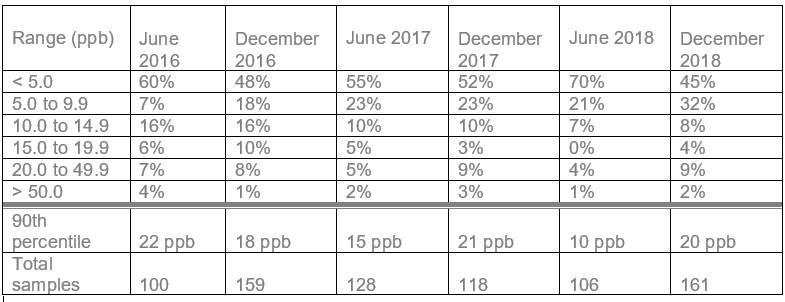
“We've seen that the 90th percentile results of compliance testing are variable. Our team is working diligently to reduce the risk of lead in water by applying
orthophosphate and rapidly replacing the lead lines in our system,” said PWSA Executive Director Robert Weimar. “We recommend that customers take advantage of our free water test kits and visit our online lead map to help determine if they’re at risk for exposure
to lead,” he continued.
As the Authority identifies the location of lead service lines, it is notifying residents directly and making the information available to the public on a searchable
online map at pgh2o.com/leadmap.
In addition, PWSA continues to offer free lead test kits to its drinking water customers.
According to EPA, there is no safe level of lead. Residents should continue to consider the recommendations provided by PWSA to reduce exposure to lead. Lead can
cause serious health problems, especially for pregnant women and young children. Although most lead exposure occurs from ingesting lead paint, dust, or lead contaminated soil, EPA estimates that 10 to 20 percent may come from drinking water. If residents know
or suspect they have lead service lines or plumbing, they are encouraged to reduce exposure in drinking water by using the following recommendations:
·
Run your water to flush out lead. If you haven’t used your water
for several hours, run your cold tap for at least one minute before using for cooking or drinking. Homes with longer lead water service lines may require flushing for a longer period of time.
·
Use cold water for cooking and preparing baby formula. Lead
dissolves more easily in hot water. Do not drink, cook with, or make baby formula using hot water.
·
Do not boil water to remove lead. Boiling water will not reduce
lead.
·
Look for alternative sources or treatment of water. Purchase
a water filter that is certified
by NSF to remove lead. Coupons for NSF-certified filters can be
found
here. Customers can also choose to drink bottled water.
·
Identify if your plumbing fixtures contain lead. There are commercially-available
lead check swabs that can detect lead on plumbing surfaces such as solder and pipes. Consider having lead-containing pipes and fixtures replaced.
·
Contact PWSA if you decide to replace your lead service line.
Depending on household income, customers may be eligible to have their lead water service line replaced at no cost.
·
Test your water for lead. Go to
pgh2o.com/leadform
or call us at 412.255.8987 to request a free lead test kit.
·
Get your child’s blood tested. If you think your child may have
been exposed to lead, talk to you doctor about testing your child. Allegheny County requires all children to be tested for lead exposure at approximately 9-12 months, and again at 24 months.
Many American cities face similar challenges posed by old lead infrastructure. PWSA is committed to working with our community to identify solutions to reduce the
risk of lead exposure. The Authority encourages customers to learn more about lead in water
http://lead.pgh2o.com.
Additional information on lead in water, including health risks and protective measures, is available at:
·
U.S. EPA Safe Drinking Water Hotline -
www.epa.gov/lead
·
Centers for Disease Control -
www.cdc.gov/nceh/lead/tips/water.htm
·
Allegheny County Health Department (ACHD) -
www.achd.net/lead
·
Pennsylvania DEP
www.dep.pa.gov/lead